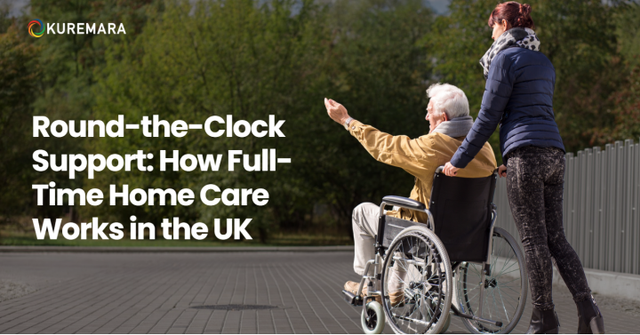
There is a moment many families recognise instantly: the realisation that occasional visits are no longer enough. Perhaps a parent with dementia is now unsafe alone at any hour. Perhaps a hospital discharge has brought needs that don’t pause at teatime. Perhaps a devoted spouse has been providing constant care and is quietly breaking under it. Whatever the trigger, the question becomes the same how do we provide continuous support without uprooting the person from the home they love?
For a long time, the assumed answer was a residential home. Yet according to Age UK, nearly 97% of older adults would prefer to stay in their own home rather than move into residential care and today, continuous support at home is a mature, well-regulated alternative rather than a luxury for the few. This guide explains how full-time home support actually works in the UK, the difference between live-in carers and rotating shift teams, what the care includes, what it genuinely costs, and how to set it up so it succeeds from the first week.
What Continuous Home Support Really Means
Continuous support means a trained carer is present in the home around the clock day, evening, and night so help is always seconds away rather than scheduled. In practice, UK families access it through two main models.
The first is live-in care: a single dedicated carer (or a small rotation of two or three who alternate placements) lives in the home, typically in their own bedroom, providing support throughout the day and remaining on hand overnight. The second is a shift-based model, where teams of carers cover the 24 hours in consecutive shifts often preferred where needs include frequent waking-night tasks, 2:1 moving and handling, or clinical interventions that make a single carer’s working pattern unsustainable.
Both models deliver genuine 24 hour care at home, and neither is universally “better” the right choice depends on the intensity of night needs, the person’s preference for one familiar face versus a wider team, the home’s spare-room situation, and budget. A capable provider will assess honestly and recommend accordingly, sometimes blending the two: a live-in carer supported by additional visiting staff at peak times, or a waking-night specialist added when nights intensify.
What both models share is the thing families actually need: no gaps. No anxious hours between visits, no unstaffed nights, no “we’ll find out in the morning.”
Why Families Choose Home Over Residential Care

The case for staying home is partly emotional familiar rooms, the garden, the neighbours, the cat but it is also practical and increasingly evidence-backed. At home, care is one-to-one rather than shared across a floor of residents; routines follow the person instead of an institutional timetable; couples are not separated (one carer can often support both, making the economics surprisingly favourable); and family involvement remains easy and natural rather than confined to visiting hours.
For older people specifically, the continuity matters even more. Well-delivered 24 hour elderly care preserves the small autonomies that residential settings often erode: waking when you like, eating what you like, keeping your own GP, your own church or club, your own front door. For people living with dementia, remaining in a deeply familiar environment can reduce disorientation and distress in ways no unfamiliar building however well designed can match. And clinically, one-to-one attention means changes in health, appetite, skin, or mood are noticed the day they begin, not at the next scheduled review.
None of this makes residential care wrong for everyone; for some people it is the right answer. But families should make that comparison knowing that continuous home support is a real, regulated, and often cost-comparable alternative not a fallback.
What Full-Time Support at Home Includes
A properly constructed package covers the whole of daily life, not a task list. Expect all of the following:
- Personal care throughout the day and night.Washing, dressing, grooming, continence support, and toileting whenever needed including overnight delivered with dignity and at the person’s own pace.
- Medication management.Prompting or administering medication on schedule across all 24 hours, with accurate records and liaison with the GP and pharmacist when regimes change.
- Meals, housekeeping, and home management.Shopping, cooking to the person’s tastes and dietary needs, laundry, and keeping the home clean and safe the practical load that otherwise falls on family.
- Mobility and falls prevention.Support with transfers, walking aids, and positioning, plus constant awareness that prevents the unwitnessed falls that so often trigger hospital admission.
- Condition-specific and clinical support.Trained assistance for dementia, Parkinson’s, stroke recovery, cancer, and palliative needs extending, with the right provider, to complex tasks delivered under proper competency frameworks.
- Companionship and life outside the house.Conversation, shared activities, accompaniment to appointments, faith services, and outings because continuous care should enlarge a person’s life, not shrink it to their bedroom.
- Family communication and records.Daily notes, proactive updates, and scheduled reviews, so relatives stay genuinely informed rather than reassured in the abstract.
If a provider’s proposal covers only some of this list, you are looking at gaps someone probably you will end up filling.
Setting It Up Well: A Step-by-Step Guide
Continuous care succeeds or fails on preparation. Work through these steps:
- Start with assessments.Arrange the provider’s home assessment, and in parallel request a local authority care needs assessment and, where relevant, an NHS Continuing Healthcare checklist. These establish the true level of need and unlock funding routes.
- Map the funding.Options include local authority personal budgets and direct payments (means-tested), NHS Continuing Healthcare for primarily health-driven needs (which can fund full packages in full), Attendance Allowance for over-66s, and self-funding. For couples sharing one live-in carer, compare the combined cost against two residential placements the difference is often striking.
- Choose the model deliberately.Be honest about nights: if the person wakes three times or needs regular repositioning, a lone live-in carer cannot sustainably cover it, and a hybrid or shift model will protect quality. Revisit this choice as needs change.
- Prepare the home.A live-in carer needs a private bedroom and reasonable facilities; agree house rules, food arrangements, breaks, and how the carer’s daily rest period (typically around two hours) will be covered.
- Insist on real carer matching.Personality fit matters enormously when someone shares your home. Expect the provider to match on experience, interests, language, and temperament and to offer a change without friction if the fit isn’t right.
- Verify governance.CQC registration and inspection history, DBS checks, reference verification, training records, and 24/7 management backup for the carer. Ask directly: who does the carer call at 3 a.m., and who covers if they fall ill?
- Build in reviews from day one.Weekly check-ins for the first month, then scheduled reviews so the package evolves with the person instead of drifting.
Families who follow this sequence typically have support running smoothly within a couple of weeks and avoid the false starts that come from rushing the match or ignoring the nights.
Spotlight: Continuous Care With Kuremara
For families across England weighing their options, Kuremara’s live-in care service illustrates what a well-governed continuous package looks like. Kuremara is a CQC-registered domiciliary care provider based in North London, delivering care across the country including London, Manchester, Birmingham, Leeds, Nottingham, and Leicester with a service range spanning live-in care, overnight support, hourly visits, respite, companionship, and complex care.
Their live-in model blends clinical capability with genuine companionship: carers are DBS-checked, reference-verified, and trained to CQC standards, with many holding specialist training in dementia care, mobility support, and medication handling, and the team supports conditions including dementia, Parkinson’s, cancer, and palliative needs. Couples can often share a single carer under one plan, making round-the-clock support markedly more cost-effective than two residential placements. If a carer is unwell or needs time off, Kuremara arranges a seamless handover or relief carer so there are no gaps in cover.
The pathway in is structured and fast: an initial consultation, a home assessment by a care manager, a bespoke care plan built around routines and clinical needs, carer matching for compatibility, and ongoing reviews with 24/7 backup from the management team with care typically arranged within 24 to 72 hours where urgency demands. Families can call 0330 111 5400 or enquire via the website for a free assessment and a transparent quote.
Making It Work for the Long Term
The first month sets the tone. Encourage the person to shape the routine rather than adapt to the carer’s; read the daily notes; and treat the early reviews as genuine steering opportunities. Good 24 hour live in care should feel less like a service installed in the house and more like life at home, quietly underpinned the person still hosting their grandchildren, still choosing their meals, still sleeping in their own bed, with skilled help woven invisibly through it all.
Watch, too, for the signs the package needs adjusting: a carer being woken nightly, weight or mood changes in the notes, or family stepping back in to fill gaps. Raising these early keeps small drifts from becoming crises and a quality provider will welcome the conversation.
Final Thoughts
Needing support around the clock does not have to mean leaving home. With the right model, the right carer match, and the right governance behind them, people with even substantial needs can continue living where their life is safely, with dignity, and on their own terms. Assess thoroughly, fund strategically, choose your provider on evidence rather than brochures, and review often. Done well, continuous home care doesn’t just look after someone; it gives a family its peace back.